This post contains affiliate links. If you buy through one, I may earn a small commission at no cost to you.
Last week I stood in my closet doing the thing I have done a thousand times, which is looking at a closet full of clothes and deciding I’ve nothing to wear.
So I ran an experiment. I picked one shirt and one pair of jeans, put them on, and refused to take them off. Then I changed everything else.
Four outfits. Same shirt. Same jeans. And the difference between them is not subtle.
Here’s what I learned, and it’s not what I expected. Because, it’s not the shoes. It’s not the bag. It’s the third piece, and once you see it you can’t unsee it.
Stylists call this the third piece rule.
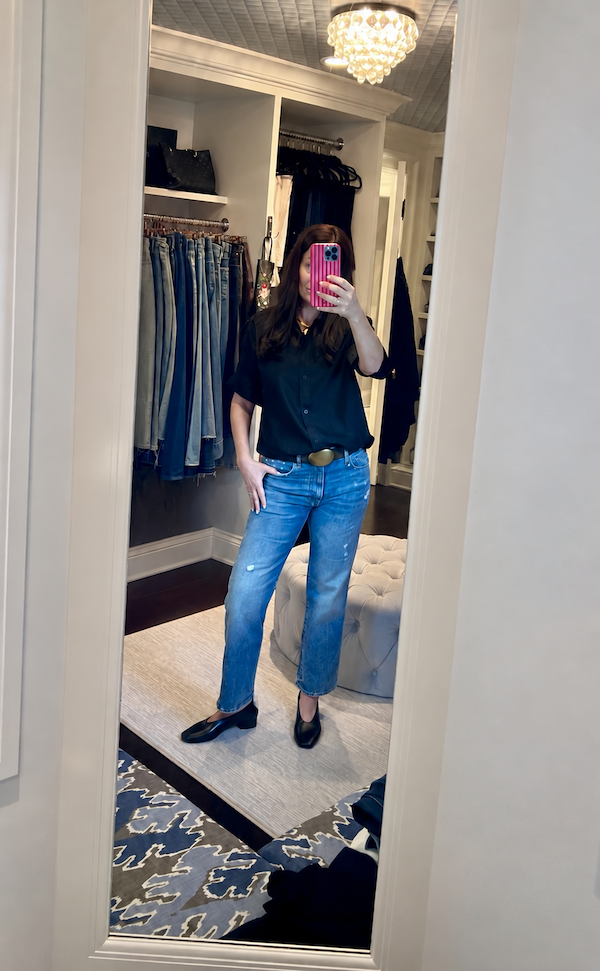
The base (aka Look One, no third piece)
A black button down, sleeves rolled up and light wash straight leg jeans. A belt with a brass oval buckle. Black flats.
That’s the whole thing.
I want to say something about why this base and not another one, because it matters more than it looks like it does.

The base has to be quiet. No pattern, no detail, nothing doing anything interesting. That sounds like a recipe for boring and it’s really the opposite. A quiet base is what lets the third piece really shine. If the shirt has a print on it, anything you put over it has to negotiate with the print, and most things lose that negotiation.
On its own, worn with the flats, this is my Tuesday. Errands, lunch, the school pickup era of my life is over but you know the outfit I mean. It’s fine. It’s not memorable, but it’s not trying to be.
OK, let’s consider the base outfit the control group. Now watch what happens.
Look one: the cream cardigan
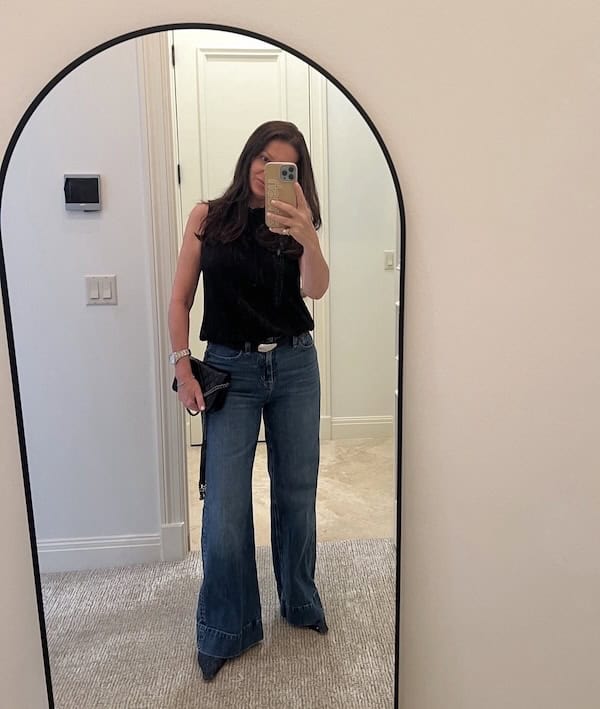
Put a cream cardigan with dark buttons over it, swap the flats for a chic pair of deep brown kitten heels, add the brown quilted clutch, and the same two pieces are now the perfect dinner outfit.
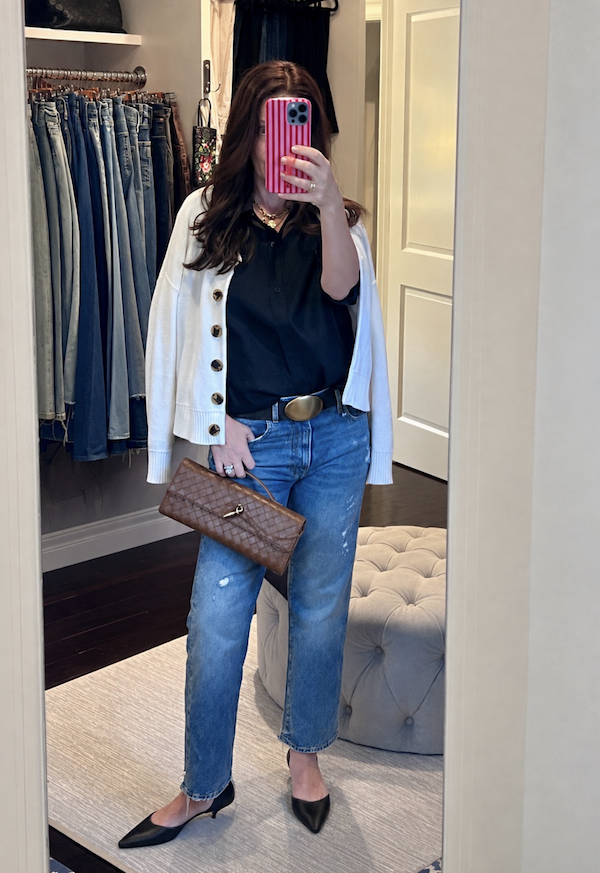
Not a fancy dinner. The kind where you’re meeting three friends somewhere with a wine list and you want to look like you put in effort without looking like you tried too hard.
The cardigan is doing something specific here. Cream against black is high contrast, and high contrast reads as deliberate. Black on black reads as you got dressed in a hurry. It’s the same reason a white shirt under a black blazer looks sharp and a black shirt under a black blazer looks like a uniform.
Look two: the embroidered cardigan
This is the one that changes the outfit the most, and it is also the one that required the least effort.

Cream with black embroidery and a blanket stitched edge, worn open over the same black shirt. I swapped the brass buckle for a black one so the belt stopped competing.
The whole outfit now has a point of view. It went from an outfit to a look, and the only thing I changed was the layer on top.
This is also the piece I would tell you to spend on if you are only buying one. A plain cardigan is a layer. An embroidered one is a statement piece. This cardigan also happens to be one of my favorite purchases this year so far.
Look three: the navy blazer
Same shirt, same jeans, navy double breasted blazer, small beaded bag, same black kitten heels.

Navy over black is a combination that keeps surprising people. It should look like a mistake and yet it never does. It looks more considered than black on black and it’s far more forgiving than it sounds, which is a thing I say constantly and will keep saying.
This is the version I would wear anywhere I wanted to be the most put together person who is still technically wearing jeans. A gallery opening. A nice lunch. Anywhere with a host stand. You get the idea…
The beaded bag is doing something clever too. A structured navy blazer is serious, and a small beaded bag with flowers on it reads playful. This tension is the whole outfit.
So what actually did the work: the third piece rule
I first went into this thinking the answer would be the shoes.
And, yet it wasn’t. Look at the three dressed up versions again and you’ll see the shoes are identical in all three
Same black kitten heel slingback, every time. The bag changes in two of them and disappears in one. The only variable that moved in every single look is the layer on top.
The third piece is the outfit. The rest is your base.
In other words, the third piece rule is real!
I think this is genuinely useful if you think about what it means for how you shop. One good base plus five third pieces is five outfits. Five complete outfits is five outfits. Same number of looks, wildly different amount of money, and easier to make room for in your closet.
A few things I noticed that make it work:
Length. All three of these hit at or just below my waist. Over a straight leg jean that is the proportion that works. Anything longer and the jeans stop being part of the outfit and start being just what’s underneath it.
Open, not buttoned. Every one of these is worn open. That vertical line down the middle is doing more for the shape than any amount of tailoring, and it’s free.
Contrast with the base, not with itself. Cream over black, navy over black. The third piece and the base should look like they are having a conversation, not an argument. If that makes sense…
Let’s talk shoes and bags
They matter, and they matter less than I assumed before I did this.
Going from the flats to the kitten heel is the one shoe change I made and it does lift the whole thing. It raises the hem of the jean off the floor, which changes the proportion, and it makes the outfit read as chosen. If you only make one swap, make it that one.
The bag is the smallest lever of the three. It’s the thing that adds the personality once the rest is settled, like the beaded bag against the navy blazer. So choose this last.
How to find your own base
Go stand in your closet and look for the two things you’d grab if you had only four minutes.
This is your base, and the fact that you reach for them without thinking is the qualification.
Then look at your third pieces. Not what you would buy, what you already own.